How Much Does an Evaporative Cooler Cool? Do the Math for Your Room in 3 Steps
The Short Answer
An evaporative cooler can bring the air coming out of it down by about half to four-fifths of the gap between your room temperature and the “wet-bulb” temperature. In dry air that gap is big, so the airflow can be 15–30°F cooler; in humid air it is small, so the drop is only a few degrees. You can work out your own number in about two minutes with a thermometer-hygrometer and one line of math, shown step by step below. For a personal cooler like AiraBreeze, that cooler airflow is what you feel at your bed or desk.

“Will it actually cool my room?” is the question everyone asks before buying an evaporative cooler, and the honest answer is: it depends on your air. The good news is that you do not have to guess. Evaporative cooling follows a simple, well-known rule that engineers use to size cooling pads, and you can apply the same rule at your kitchen table. Here is the formula in plain English, a worked example, a ready-made table for five common situations, and where a personal cooler fits into your result.
Why Humidity Decides Everything
An evaporative cooler pulls warm air across a wet pad or filter. Some of the water evaporates, and evaporation uses heat from the air, so the air leaves cooler and slightly more humid. (Our guide do evaporative air coolers actually work? explains the principle in full.)
There is a hard floor to this process: the wet-bulb temperature. That is the lowest temperature air can reach by evaporating water into it. Dry air can soak up a lot of water, so its wet-bulb temperature sits far below the normal thermometer reading. Humid air is already close to full, so its wet-bulb temperature is close to the normal reading. No evaporative cooler can push air below the wet-bulb line, and real coolers stop somewhat short of it. The U.S. Department of Energy’s Energy Saver 101 guide to home cooling makes the same point in practical terms: it presents evaporative coolers as a cost-effective option for arid climates.
The Formula (One Line)
| Step | What you calculate |
|---|---|
| 1. The gap | Room temperature − wet-bulb temperature |
| 2. The drop | Gap × effectiveness (use 0.5 for a cautious estimate, 0.8 for a best case) |
| 3. Outlet air | Room temperature − drop |
Effectiveness is how close a cooler gets to the wet-bulb limit. Engineering references, such as the evaporative-cooler section of the U.S. DOE’s EnergyPlus building-simulation documentation, define it exactly this way: the actual temperature drop divided by the room-to-wet-bulb gap. Large pads with good airflow often reach roughly 75–80% under ideal conditions; small and personal units, higher fan speeds and partly dry pads land lower. That is why we show a range from 50% to 80% instead of a single promise.
A Worked Example, Step by Step
Say it is a late-summer afternoon and your bedroom reads 85°F and 30% relative humidity on a cheap indoor thermometer-hygrometer.
- Find the wet-bulb temperature. Enter 85°F and 30% into any free wet-bulb calculator (the National Weather Service publishes simple weather calculators), or use the table below. The answer is about 64°F.
- Work out the gap. 85 − 64 = 21°F. That is the most cooling the physics allows in that air.
- Apply effectiveness. Cautious case: 21 × 0.5 = 10.5°F. Best case: 21 × 0.8 = about 17°F.
- Get the outlet temperature. 85 − 10.5 = about 75°F (cautious) or 85 − 17 = about 68°F (best case).
So in that bedroom, the breeze coming off the cooler should feel somewhere between the mid-70s and the high-60s, which is a very noticeable change when it is aimed at you from a nightstand.
Ready Table: 5 Common Situations
Wet-bulb values below are calculated with a standard meteorological approximation and rounded; your own readings will vary.
| Situation | Room air | Wet bulb | Gap | Outlet air at 50% | Outlet air at 80% |
|---|---|---|---|---|---|
| Desert afternoon (e.g. Phoenix) | 105°F, 10% RH | 66°F | 39°F | about 85°F | about 74°F |
| High, dry city (e.g. Denver) | 90°F, 20% RH | 63°F | 27°F | about 77°F | about 69°F |
| Warm bedroom, moderate air | 85°F, 30% RH | 64°F | 21°F | about 75°F | about 68°F |
| Heated room in winter | 75°F, 25% RH | 55°F | 20°F | about 65°F | about 59°F |
| Humid Gulf Coast (e.g. Houston) | 92°F, 60% RH | 81°F | 11°F | about 86°F | about 83°F |
Two things jump out. First, dry places get big drops, which is why the classic swamp cooler grew up in the American Southwest (see the history of evaporative cooling). Second, the winter row is not a typo: indoor heating dries the air, so a stuffy, overheated bedroom or office in November has plenty of room for evaporative cooling, plus the cooler adds back a little moisture.
What the Number Means (and What It Doesn’t)
- It is the air leaving the cooler, not the whole room. A personal cooler cools the zone it is pointed at. Expect the full effect within a few feet, and a much smaller change across a large open room.
- Moving air adds to the feeling. A steady breeze over your skin makes you feel cooler than the thermometer alone suggests, which is why placement close to you matters.
- Humidity rises as you run it. In a sealed room the humidity creeps up, the gap shrinks and the effect fades. Crack a window or door to let moist air out; our tips for colder air cover this.
- High humidity is the real limit. If your gap is under about 10°F, expect a refreshing breeze rather than a big temperature drop.
Where a Personal Cooler Fits Your Result
Look at your own gap. If it is 15°F or more, which covers dry climates, most hot bedrooms and nearly every heated room in winter, an evaporative cooler aimed at you will deliver a clear, easy-to-feel drop for very little electricity and zero installation. If you mainly overheat in one spot, a small unit right next to you uses that cooling far better than a large unit across the room, a point we unpack in mini vs. tower vs. window coolers.
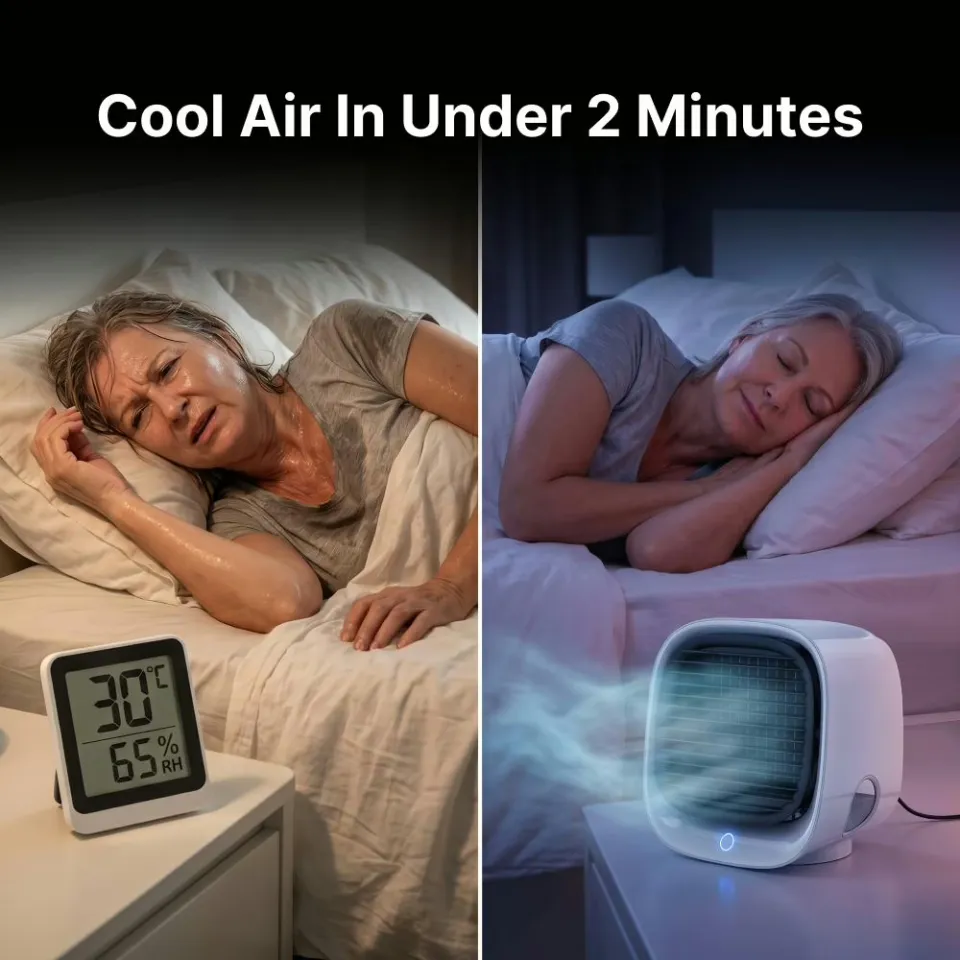
Our Recommendation: AiraBreeze
Once the math shows your air has room to cool, the simplest way to put that cooling where you actually feel it is AiraBreeze, the personal evaporative cooler we recommend. It is built for exactly this job: a compact unit that cools, filters and humidifies the air around you, rated for spaces up to 215 sq ft, with nothing to install. Fill the tank, plug it in, press the button.
- Noticeable cooling in about 90 seconds: you feel the drop almost right away.
- Up to 8 hours per fill: enough for a full night or a work day.
- 3 fan speeds: low is quiet enough to sleep next to.
- Add ice for extra-cool air: a colder first blast on the hottest afternoons.
- Adds gentle moisture: welcome in rooms dried out by winter heating.
- Light and portable: nightstand at night, desk by day.
Owners rate it 4.7/5 across 1,888+ reviews, and 97% say they would recommend it. The official site currently offers 75% OFF, and every order is covered by a 30-day money-back guarantee, so you can test your own numbers at home. It is a personal and small-room cooler, not a replacement for central air. Read our full AiraBreeze review for specs and owner feedback.
Frequently Asked Questions
How many degrees does an evaporative cooler cool?
It depends on how dry the air is. The air leaving the cooler can drop by roughly half to four-fifths of the gap between the normal (dry-bulb) temperature and the wet-bulb temperature. In dry heat that gap is 25 to 40°F, so the outgoing air can be 15 to 30°F cooler; in humid weather the gap may be only about 10°F, so the drop is much smaller.
What is the formula for evaporative cooler temperature drop?
Outlet air temperature = room temperature minus effectiveness times (room temperature minus wet-bulb temperature). Effectiveness is how close the cooler gets to the wet-bulb limit, often around 50 to 80 percent depending on the pad, airflow and fan speed.
At what humidity does an evaporative cooler stop working?
There is no single cut-off, but the cooling effect shrinks as humidity rises. Below about 30 to 40 percent relative humidity the drop is large and easy to feel. Above about 60 percent the gap to the wet-bulb temperature is small, so the air comes out only a few degrees cooler, although the moving air can still feel pleasant up close.
Does an evaporative cooler lower the temperature of the whole room?
The formula tells you the temperature of the air coming out of the cooler. A personal cooler mainly cools the space it is pointed at, so you feel the biggest difference within a few feet of it. The rest of a large room changes much less.
How do I find the wet-bulb temperature for my room?
Read the temperature and relative humidity on a simple indoor thermometer-hygrometer, then enter both numbers in a free online wet-bulb calculator, such as the weather calculators published by the National Weather Service, or use the ready table in this article.
Does adding ice make an evaporative cooler colder?
Ice or very cold water lowers the temperature of the water the air passes over, so the first stretch of airflow feels colder. The main cooling still comes from evaporation, which is why dry air matters more than ice.
New here? Browse more honest home-product reviews on our Review Elite home page, or see how cooling options compare in portable cooler vs. AC vs. fan.