Do Fans Help in Extreme Heat? How the Advice on Fans Changed, and What to Follow Today
The Short Answer
Fans help in hot weather up to a point, and where that point sits is exactly what changed. For years, public-health advice used one simple line: around 35°C (95°F), stop relying on a fan. Research since 2019 showed the answer depends on humidity, age and medication: fans help more in humid heat and for healthy younger adults, and can backfire in very hot, dry air or for older people. Today’s practical rule: use moving air for comfort, but in dangerous heat, especially if you are 65+ or on certain medicines, get to air conditioning. A personal evaporative cooler like AiraBreeze fits the everyday comfort part of that plan.
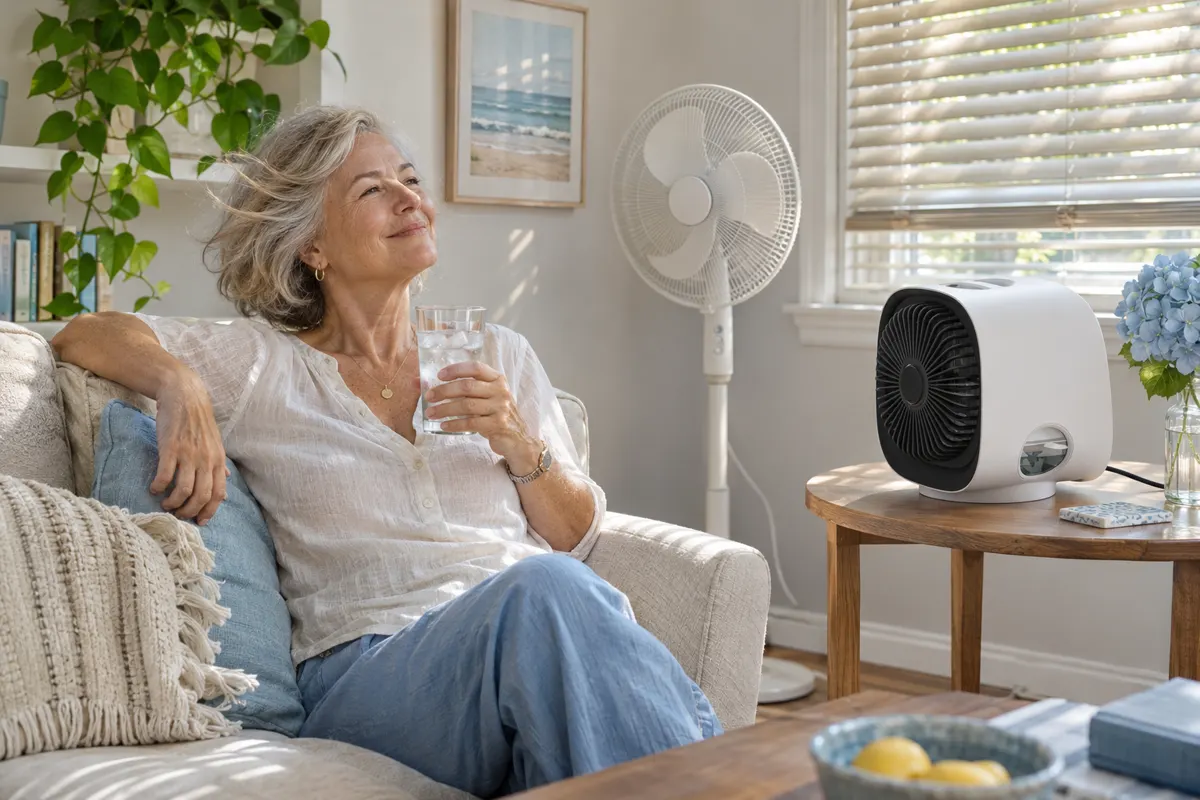
“Are fans actually safe in a heat wave?” is one of those questions where you can find confident answers in both directions. Some articles say a fan is a lifesaver; others say it is a convection oven. Both have a point, because the official advice itself has been moving. Below we lay out what the guidance said before, what researchers found, where the experts still disagree, and the simple rules you can follow today. We only include what we could find documented, with the year.
Why a Fan Cools You (and When It Stops)
A fan never lowers the air temperature. It cools you in two ways: moving air carries heat away from your skin, and it speeds up the evaporation of sweat, which is the body’s main cooling system. Both work well while the air is cooler than your skin. Once the air gets hotter than skin temperature, roughly in the mid-90s °F, moving air starts adding heat instead of removing it, and only sweat evaporation is still on your side. That is why humidity, sweating ability and age decide whether a fan helps or hurts.
The Advice That Changed: Before, Today and Why
| Before | Today | Why it changed | Source |
|---|---|---|---|
| One simple line: above about 35°C (95°F), fans should not be relied on | Thresholds that depend on humidity, age and medication | Physiology lab studies and climate modelling showed the 35°C line was too low for healthy young adults in many conditions | WHO simplified threshold; Morris et al., The Lancet Planetary Health, 2021 |
| “Fans do not work in a heat wave,” regardless of climate | Fans help more in humid heat; in very hot, dry heat they can make heat stress worse | A University of Sydney lab study (2019) found opposite results in humid vs. very dry extreme heat | Study reported by STAT News, August 2019 |
| Same fan advice for everyone | Extra caution for adults 65+ and people on medications that reduce sweating | Older bodies sweat less; a 2024 review and a JAMA study in older adults found fans gave little or no core cooling in extreme heat | Meade et al., The Lancet Planetary Health, 2024; JAMA study of older adults |
1. From one number to several
For years the World Health Organization’s heat-health advice used a simplified 35°C threshold for fan use, and the U.S. CDC has long warned that when temperatures reach the high 90s °F, electric fans will not prevent heat-related illness. In 2021, a team led by Nathan Morris with Ollie Jay at the University of Sydney published a biophysical modelling study in The Lancet Planetary Health covering 108 large cities. They proposed raising the fan threshold to about 39°C for healthy young adults, 38°C for healthy adults over 65 and 37°C for older adults taking anticholinergic medication. Their reason: the simple 35°C rule was telling many people to switch off a fan on days when it would still have helped.
2. Humid heat and dry heat are not the same problem
The same research group had already shown, in a 2019 lab study reported by STAT News, that fans were helpful in very hot and humid conditions but harmful in very hot and dry conditions. The 2021 modelling followed the same logic and concluded that fan use alone should not be routinely recommended in places with regular extreme dry heat, naming northern India, Pakistan, the Middle East and the southwestern United States. If you live in Phoenix or Las Vegas, “just use a fan” was never good advice for the worst days.
3. Older adults: the debate is still open
Not everyone agreed with raising the threshold. A 2024 critical review in the same journal (Meade and colleagues) argued that health agencies should keep advising against fan use above 35°C, especially for people with reduced sweating such as adults 65 and older. A JAMA study of older adults exposed to extreme indoor heat found that fans did not lower peak core temperature and concluded they should not be treated as a standalone cooling measure for that group. So the newest evidence pulls in two directions: more room for fans in healthy younger people, more caution for older ones.
What to Follow Today
| Situation | Fan alone? | Better plan |
|---|---|---|
| Warm day, below the mid-90s °F | Yes, it helps | Fan or personal cooler, shade, water |
| Humid heat, healthy younger adult | Often helpful | Fan plus wet skin or a cool shower; take breaks somewhere cooler |
| Very hot, dry heat (desert climates) | No | Air conditioning or a cooling center during peak hours |
| Adult 65+ or on medicines that reduce sweating | Do not rely on it above about 35°C (95°F) | Air conditioning, fluids, check-ins from family; ask a doctor about medications |
| Signs of heat stroke (confusion, very high body temperature) | No | Call 911 |
Two habits make any fan or cooler work better. First, block the sun: closed blinds on sunny windows keep heat out in the first place (more in how to stay cool without AC). Second, cool the person, not just the room: a cool shower, wet cloth on the neck or damp skin in moving air speeds up evaporation, which is the part of cooling that still works when the air is hot.
Where a Personal Evaporative Cooler Fits
A fan only moves the air that is already there. A personal evaporative cooler pulls that air through a water-soaked filter, and the evaporating water absorbs heat, so the air comes out cooler, filtered and gently humidified. That makes it a step up from a fan for the everyday hot afternoon or warm night, and it works best in drier air, which is exactly the condition where a plain fan struggles. We explain the physics in do evaporative air coolers actually work? and compare the options in portable cooler vs. AC vs. fan.
Be clear about the limits, too. A personal cooler is built for the space around your chair, desk or bed, not for a whole house, and it is not a substitute for air conditioning during a dangerous heat wave, especially for older adults. Think of it as your daily comfort tool, with AC or a cooling center as the plan for extreme days.
Our Recommendation: AiraBreeze
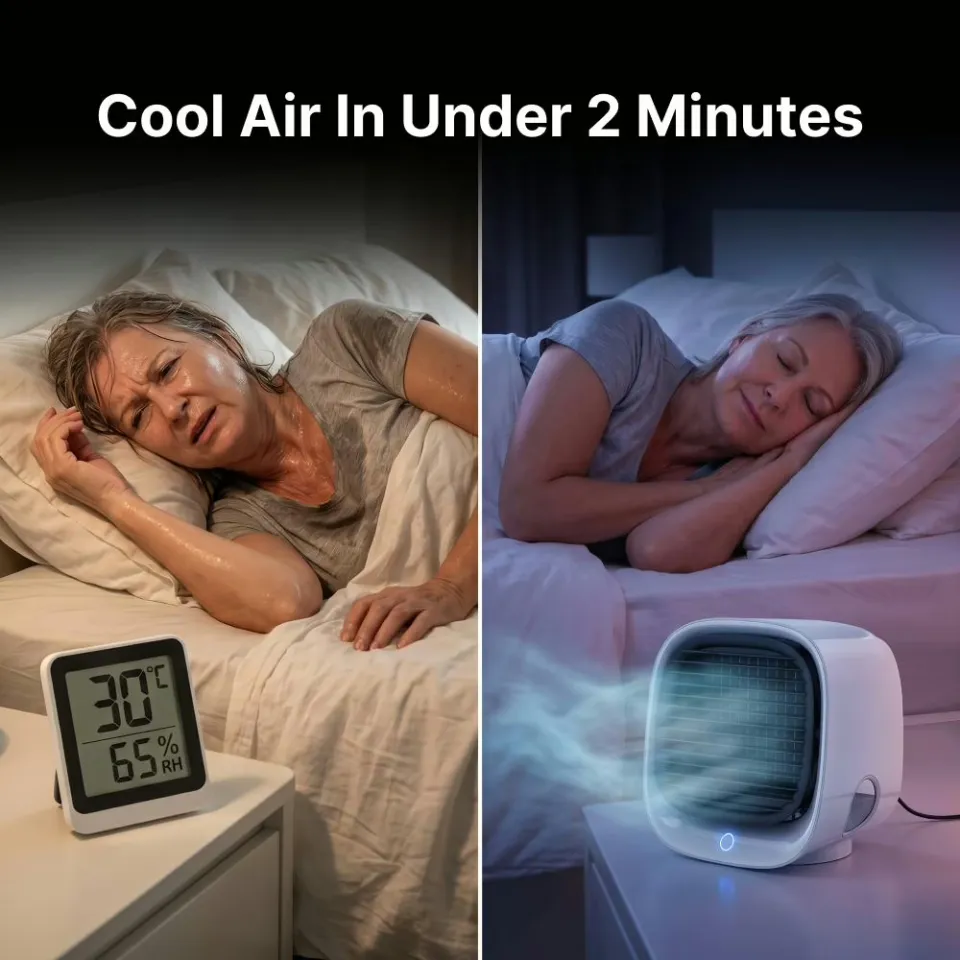
For the hot afternoons and warm nights that make up most of summer, the upgrade from a fan that we recommend is AiraBreeze. Instead of pushing warm air around, this compact personal evaporative cooler cools, filters and humidifies the air it moves, in a space of up to 215 sq ft, with nothing to install. Fill the tank, add ice on the hottest evenings, plug it in and point it at your desk, sofa or pillow. It is the simplest way we know to get genuinely cooler air where you sit, while keeping your air conditioner for the days that truly need it.
- Noticeable cooling in about 90 seconds: cooler air than a fan, right where you are.
- Up to 8 hours per fill: enough for a full night or a long workday.
- 3 fan speeds: low is quiet enough to sleep next to.
- Filters the air it moves: a fresher feel around your desk or bed.
- Add ice for extra-cool air: a colder first blast on warm evenings.
- Light and portable: nightstand at night, desk by day, guest room when needed.
Owners rate it 4.7/5 across 1,888+ reviews, and 97% say they would recommend it. The official site currently offers 75% OFF, and every order is covered by a 30-day money-back guarantee. Read our full AiraBreeze review for specs and owner feedback.
Frequently Asked Questions
Do fans help in extreme heat?
Up to a point. Moving air helps sweat evaporate, so a fan can make you feel and stay cooler in hot weather, especially when it is humid. But when the air is hotter than your skin, roughly above 35°C (95°F), a fan can start blowing heat at you, particularly in very dry heat and for older adults. In extreme heat, the most protective step is time in an air-conditioned space.
At what temperature is a fan no longer useful?
For years the WHO used a simple 35°C (95°F) threshold. A 2021 modelling study in The Lancet Planetary Health proposed raising it to about 39°C for healthy young adults, 38°C for healthy adults over 65 and 37°C for older adults taking anticholinergic medication. A 2024 review in the same journal argued that agencies should keep advising against fan use above 35°C for older adults. The safe reading: the older or more medicated you are, the earlier you should stop relying on a fan alone.
Are fans safe for older adults in a heat wave?
Fans can add comfort, but they should not be the only protection for people 65 and older in extreme heat. Older bodies sweat less, and a JAMA study of older adults in extreme indoor heat found that fans did not lower their peak core temperature. Air conditioning, a cooling center, fluids and regular check-ins are the safer plan.
Is a personal evaporative cooler better than a fan in hot weather?
A fan only moves air; an evaporative cooler passes the air through water so it comes out cooler, and it works best in dry heat, which is exactly where fans struggle most. A personal cooler is made for the space around you, not for a whole house, and it does not replace air conditioning during dangerous heat.
What should I do in a heat wave if I do not have air conditioning?
Spend the hottest hours somewhere air-conditioned, such as a library, mall or official cooling center; drink water regularly; wet your skin with cool water; block sun with blinds; and check on older relatives and neighbors. Seek medical help for signs of heat stroke, such as confusion or a very high body temperature.
New here? Browse more honest home-product reviews on our Review Elite home page, or read our complete portable air cooler guide.