Portable Air Cooler vs. Air Conditioner vs. Fan: Which Should You Buy in 2026?
The Short Answer
They are three different tools, and the right one depends on the size of the problem. An air conditioner is the only machine that can pull a large, sealed space far below outdoor temperature — and it charges you for that power on every hydro bill, plus installation your condo board may simply refuse. A fan is cheap and simple but never cools the air a single degree; on the muggiest nights it just stirs the heat. The portable evaporative cooler sits in the sweet spot for the most common problem — one hot bedroom, office or dorm up to about 215 sq ft: genuinely cooler air, zero installation, quiet, and running costs closer to a fan than an AC. That sweet spot is exactly where our top pick, the AiraBreeze (4.7/5), lives.
Type "how to cool a room" into any search bar and three machines come back at you: the fan you already own, the air conditioner you are afraid to run, and a newer category — the portable air cooler — that half the internet swears by and the other half has never tried. They get marketed as interchangeable. They are not even close.
Each one uses completely different physics, and the physics decides what it can and cannot do for you. So before you spend anything (or resign yourself to another sticky August), here is the honest side-by-side.
First, What Each Machine Actually Does
- Fan: moves air. That is the whole trick. Moving air helps your sweat evaporate, which cools you — but the air itself stays exactly as hot as it was. In a room sitting at 32 degrees, a fan is a convection oven on its lowest setting.
- Air conditioner: uses a refrigerant compressor to strip heat from indoor air and dump it outside. It genuinely lowers room temperature, even in a big sealed space — and pays for that power with the highest purchase price, the highest running cost, installation (window kit or ducting), and compressor noise.
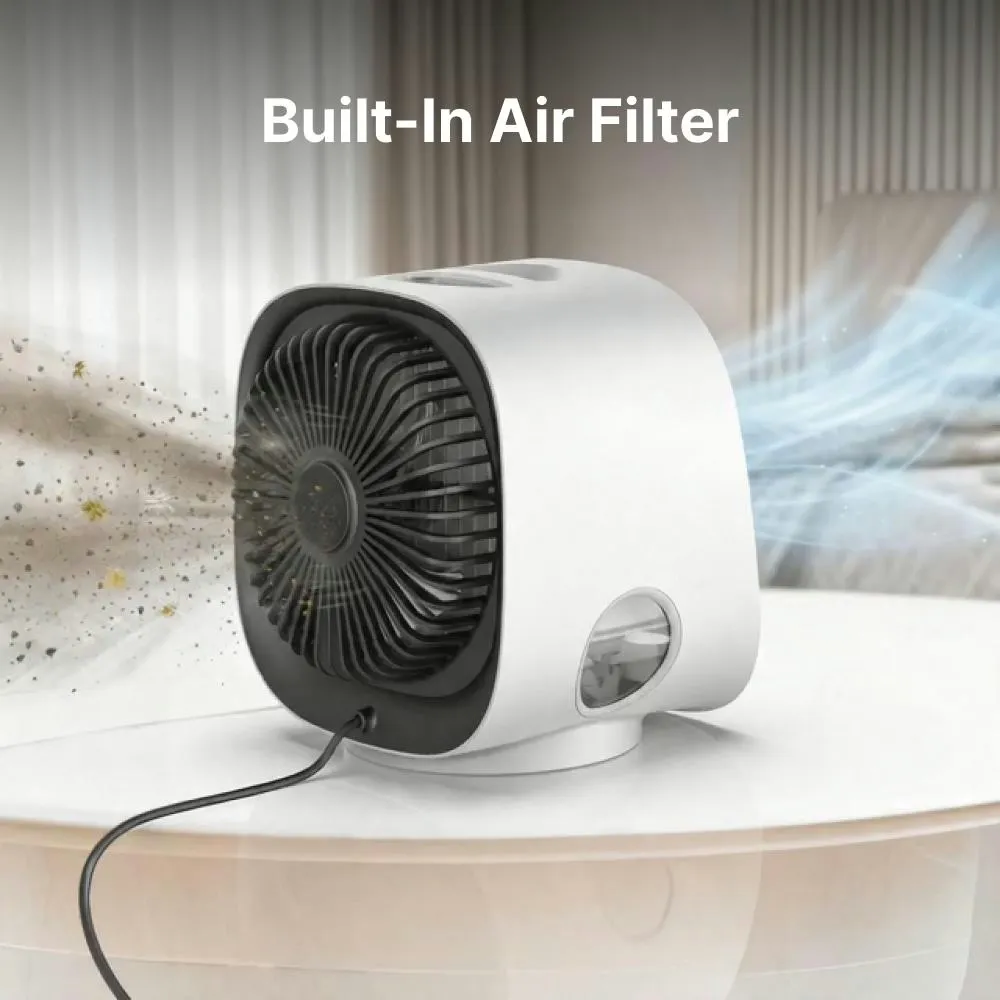
- Portable evaporative cooler: pulls warm air through a water-soaked filter; the evaporating water absorbs heat and the air comes out genuinely cooler, filtered and gently humidified. Only a small fan and pump draw power. No installation at all — fill the tank and plug it in.
The Side-by-Side Comparison
No prices here on purpose — deals change weekly. This is about what each machine is, qualitatively, so you can match the tool to your actual problem:
| Portable Air Cooler | Air Conditioner | Fan | |
|---|---|---|---|
| Cooling power | Genuinely cools personal spaces up to ~215 sq ft | Strongest — cools large sealed rooms | None — moves air, never cools it |
| Running cost | Very low — small fan + pump only | High — the compressor eats hydro | Very low |
| Installation | None — fill tank, plug in | Window kit, ducting or professional install | None |
| Noise | Ultra-quiet on low — sleep-friendly | Compressor hum and cycling | Quiet to moderate |
| Portability | One-hand carry, room to room (or to the cottage) | Heavy; fixed once installed | Portable |
| Air quality | Filters, humidifies and purifies | Dries the air; filters vary | Recirculates dust as-is |
| Best for | Bedrooms, offices, dorms, condos, renters | Whole homes and large sealed rooms | Mild days; boosting other cooling |
Match the Machine to Your Situation
Buy (or keep) the fan if…
…your summers are mild, your problem is stuffiness rather than heat, or you want a cheap sidekick to boost another cooling method. A fan is also the right tool for the night-time cross-breeze trick in our no-AC guide. Just know its ceiling: on a genuinely hot night, a fan alone recirculates hot air — which is why you can sit in front of one, sweating, wondering why it is not working. It is working. It just cannot do what you are asking.
Go air conditioner if…
…you need to cool a large open space or an entire home, sealed windows and all, regardless of humidity — and you have the budget for the unit, the installation and the summer of hydro bills that follows. That is real capability, and for whole-house cooling through a Southern-Ontario-style heat wave nothing else does the job. Our honesty rule applies in both directions: no personal cooler replaces central air, and we will never tell you otherwise. The question is whether your problem is actually a whole-house problem — for most people losing sleep in one hot bedroom, it is not.
Go portable evaporative cooler if…
…your problem is the one most people actually have: one specific space that becomes unbearable — the bedroom at night, the home office all afternoon, the dorm room, the cabin at the lake. Here the cooler's trade-offs all point the right way. It genuinely lowers the temperature of the air reaching you (unlike the fan), costs a small fraction of an AC to run (it powers no compressor), needs zero installation (renters and condo dwellers welcome — no board approval required), moves room to room with one hand, and — uniquely among the three — filters, humidifies and purifies while it cools. One honest caveat: evaporative cooling is at its spectacular best in dry air; on the muggiest humidex days the effect is milder, more "better fan with a cooling edge" than "personal winter."
Our Verdict
For cooling the space you are actually in, the portable evaporative cooler is the smart money in 2026 — and after comparing the specs and owner reviews of the current crop, the one we recommend is the AiraBreeze. It hits every mark that matters in this category: noticeably cooler air in about 90 seconds, coverage for spaces up to 215 sq ft (about 20 square metres), a tank that runs up to 8 hours per fill (a full night's sleep), 3 speeds, and it is genuinely quiet enough to live on a nightstand. It is rated 4.7/5 by 1,888+ owners, with 97% saying they would recommend it — and it is covered by a 30-day no-questions money-back guarantee, so testing it against your own heat wave is risk-free.
Frequently Asked Questions
Is a portable air cooler better than a fan?
For actually feeling cooler, yes. A fan only moves air — it never lowers the temperature, and in a very hot room it is effectively blowing hot air at you. An evaporative cooler passes that same airflow through a water-soaked filter first, so the air reaching you is genuinely cooler and gently humidified. The fan wins on exactly one front: it is the cheapest to buy and needs no water.
Can a portable air cooler replace an air conditioner?
No — and distrust anyone who claims it can. An AC compressor can pull a large sealed room far below outdoor temperature; no evaporative device matches that. The honest comparison is scope: whole-house cooling is AC territory, while cooling the personal space you occupy — up to about 215 sq ft, about 20 square metres — is where the evaporative cooler delivers most of the felt relief at a small fraction of the hydro cost, with zero installation.
Do evaporative coolers work in humid climates?
They are at their best in dry air, where evaporation is fastest — Prairie summers are their happy place. On a muggy Great Lakes humidex day the cooling effect is smaller but not zero, and the filtered, moving air still helps your sweat evaporate. Set expectations accordingly: remarkable in dry heat, a better and cleaner fan with a mild cooling edge in muggy heat.
What's cheapest to run?
Fan first, evaporative cooler a close second, air conditioner in a different league. Fans and evaporative coolers run small motors; the cooler adds only a little water pump. An AC runs a compressor — among the most power-hungry appliances in a home — which is why summer hydro bills sting. Per degree of felt relief, the evaporative cooler is usually the best value of the three.
Which is best for a bedroom at night?
For most people, a quiet portable evaporative cooler. Window ACs overcool and their compressor cycling wakes light sleepers; a fan alone just stirs warm air on the worst nights. A good evaporative cooler on low delivers genuinely cooler, humidified air quietly — and one with an 8-hour tank runs the whole night on a single fill.